
Rest & Recovery
The Right-Side Sleep Guide for Women
Ergonomics, spine alignment and DIY pillow support for the Sunnah sleep position.
Help Review Welliyah Articles
We welcome qualified female healthcare professionals and Islamic educators to contribute to and review Welliyah content.
Interested in becoming a reviewer?
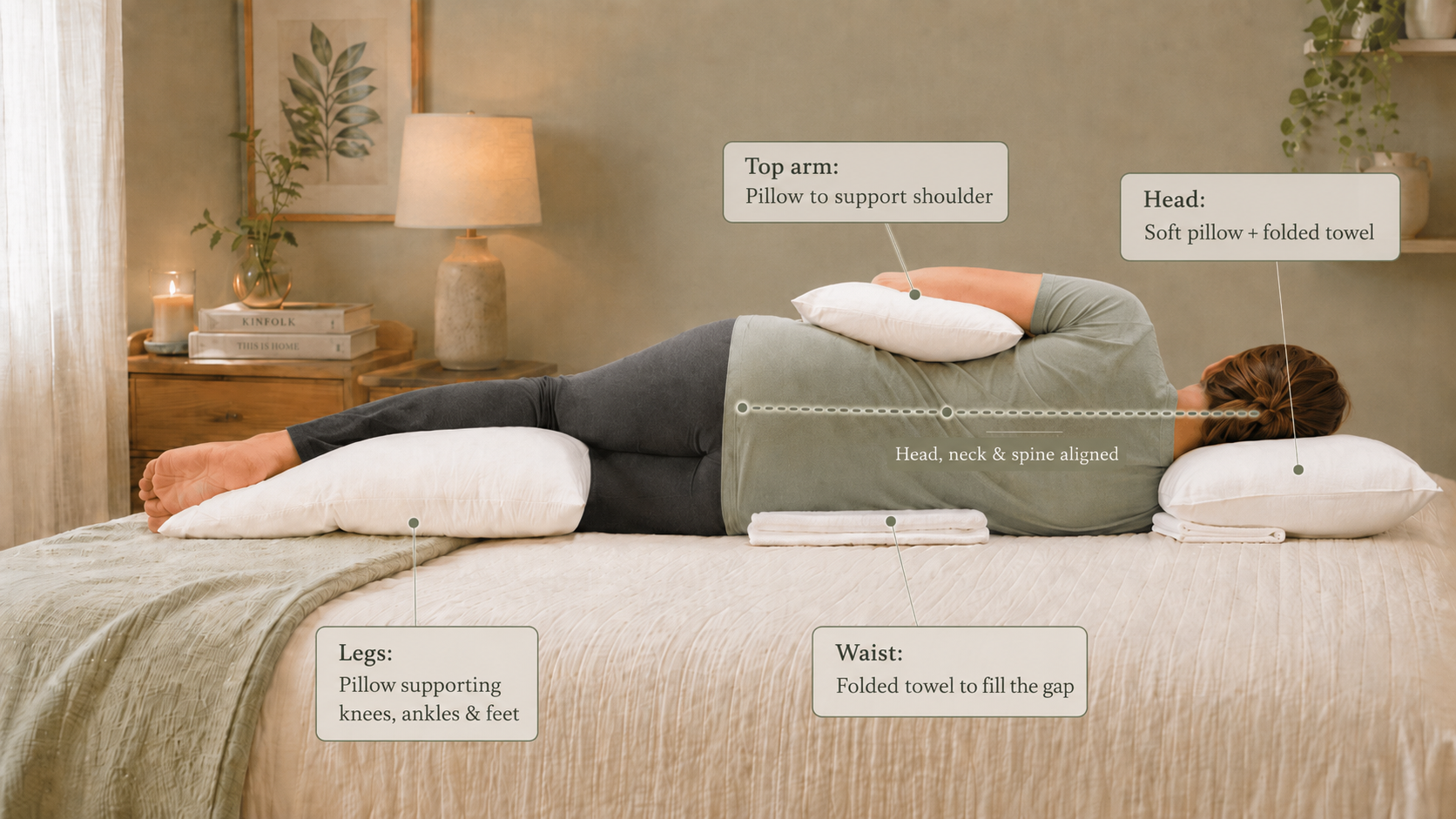
Lying on your right side is a cherished Sunnah — and modern science shows it can reduce cardiovascular strain, ease digestion and shift the nervous system into rest-and-digest mode. But because women naturally have wider hips relative to their waist and shoulders, side sleeping without support can twist the lumbar spine, strain neck muscles and wake you up sore.
Here is how to align your posture for every life stage, adapt your setup with simple household items, and create effortless DIY pillow supports that keep your spine straight while you honour the prophetic sleep position.
The tradition. The Prophet Muhammad ﷺ said: "Whenever you go to bed, perform ablution like that for the prayer, and lie on your right side." — Sahih Muslim (2710). The practice of placing the right hand under the right cheek is also recorded in Sahih al-Bukhari (247).
The backed science.
- Cardiac and nervous-system ease. Lying on the right side keeps the heart higher in the chest cavity and reduces pressure from the lungs. Spectral heart-rate-variability studies show right-side lying can increase vagal tone and lower sympathetic drive, helping the body settle into parasympathetic "rest-and-digest" mode.
- Pelvic and lumbar mechanics. Women generally have a wider pelvic structure. Without support, the upper leg drops forward and rotates the pelvis, placing torsional stress on the L4–L5 vertebrae and sacroiliac (SI) joints.
- Gastrointestinal comfort. Right-side positioning follows the natural curve of the stomach and the ileocecal valve, allowing gastric contents to settle and reducing late-night bloating and acid reflux.
- Vascular flow in pregnancy. For pregnant women, side-lying — whether right or left — keeps the heavy uterus from compressing the inferior vena cava, supporting maternal-fetal circulation.
Physiotherapists recommend tailoring your right-side sleep posture to your body's changing biomechanics. Use these setups as a starting point and adjust for comfort.
- General / reproductive-health stage. Focus on preventing hip rotation and neck lateral flexion. Use a medium-firm head pillow that fills the distance between your ear and shoulder tip. Place a firm pillow between your knees and ankles to keep them stacked and prevent pelvic twist.
- Pregnancy stage (2nd & 3rd trimester). Focus on uterine support and SI-joint relief. Place a long body pillow or folded wedge under your bump, between your knees, and behind your back to stop you rolling flat. Keep knees gently bent in a soft fetal posture.
- Perimenopause & menopause stage. Focus on thermal regulation and joint-pressure relief. Choose breathable, moisture-wicking linen or cotton pillow covers. Add a soft contour pillow between knees and ankles to cushion sensitive knee-joint spaces.
You do not need expensive orthopaedic pillows to achieve a neutral spine. Standard household hand towels and extra pillows, folded to fit your own frame, are what physiotherapists reach for first.
Three rules before you start:
- Use only one pillow under your head.
- Choose a softer pillow — a firm one stops the head and neck muscles from truly relaxing.
- Keep a few hand towels and extra pillows within reach.
- Step 1: Head and neck — do this first, whatever position you sleep in. Fold a hand towel into quarters (in half, then in half again) and place it under your pillow so it sits directly beneath the base of your skull. Add another folded towel if needed, until your head is supported enough that your neck no longer feels bent. If you find yourself tucking your arm under the pillow, that is a sign you need more support, not more arm: remove the arm and add a towel instead.
- Step 2: Support the top arm and shoulder. Lying on your right side, hug one pillow under your top (left) arm. This stops the shoulder collapsing forward and rotating the upper spine — a common reason women wake with neck and shoulder ache.
- Step 3: Fill the waist gap. Fold one or two hand towels and lay them lengthways directly under your torso, in the space between your bottom rib and the top of your hip. Because women typically have a narrower waist relative to the ribcage and hips, this is where the mid-spine sags most; filling it keeps nose, sternum and navel in one straight horizontal line.
- Step 4: Support the legs from hip to foot. Place a pillow between your legs so it contacts every point — knees, ankles and feet, not just the knees. A full body pillow is ideal. This keeps the hips stacked and prevents torsional strain through the L4–L5 vertebrae and sacroiliac joints.
- Step 5 (optional): staying in position. A firm pillow or folded towel tucked behind your back is a gentle reminder to stay on your right side rather than rolling onto your stomach.
- If you sometimes rest on your back. Keep the natural S-curve: one low-profile pillow with a folded towel under the base of the neck, and one or two firm pillows under bent knees — never flat with straight legs — so the pelvis tilts back and the lower back rests against the mattress.
Pick one or two adjustments tonight and build from there. Consistency matters more than perfection.
- Head: one soft pillow only, with a quarter-folded hand towel beneath it at the base of the skull.
- Right side: a pillow under the top arm so the shoulder does not roll forward.
- Right side: a folded hand towel lengthways under the waist, between bottom rib and hip.
- Right side: a pillow (or body pillow) between the legs, touching knees, ankles and feet.
- Face-up (back): place pillows under bent knees to prevent lower-back arching.
- All positions: choose breathable natural-fibre bedding and keep the room dark and cool.
Honouring the Sunnah sleep position does not mean putting up with a sore neck or aching lower back. With a few intentional supports, right-side sleeping becomes a sustainable, restorative habit that protects your spine through every season of a woman’s life.
Start with the towel roll tonight. Your body — and your next morning — will thank you.
Educational summary only — Welliyah does not provide medical advice. If you have persistent neck pain, back pain, reflux, numbness or pregnancy-related sleep disturbance, speak with a qualified clinician or physiotherapist.
Frequently asked questions
- Why does Islam recommend sleeping on the right side?
- The Prophet ﷺ instructed believers to lie on their right side after performing wudu before bed (Sahih Muslim 2710). The position is also linked with placing the right hand under the right cheek (Sahih al-Bukhari 247). Beyond the spiritual recommendation, modern physiology notes that right-side lying can reduce cardiac compression and support parasympathetic tone.
- Can sleeping on my side hurt my lower back?
- Side sleeping without support can twist the pelvis and lumbar spine, especially for women with wider hips relative to waist and shoulders. Placing a firm pillow between the knees and ankles keeps the hips stacked and prevents torsional strain on the L4–L5 vertebrae and sacroiliac joints.
- What pillow height is best for side sleepers?
- Your pillow should fill the exact distance between your ear and the tip of your shoulder, keeping your neck in a straight line with your spine. A pillow that is too flat bends the neck downward; one that is too thick tilts the head upward. A small rolled towel inside the pillowcase can add custom neck support.
- Is it safe to sleep on my right side during pregnancy?
- Both left- and right-side sleeping are generally recommended in later pregnancy because they keep the uterus from compressing the inferior vena cava, the large vein that returns blood to the heart. A long body pillow or wedge under the bump, between the knees, and behind the back can make the position comfortable and stable.
- How do I stop myself from rolling onto my stomach?
- Place a firm pillow or folded towel behind your back when lying on your right side. The gentle barrier reminds your body to stay lateral and makes rolling onto your stomach less comfortable, helping you maintain the Sunnah position through the night.
Sources & further reading
Every claim in this article is traced to either an authentic Islamic source or peer-reviewed research and public health guidance.
Islamic sources
Science & clinical research
- 3.Cary D et al. (2019) — "Identifying relationships between sleep posture and non-specific spinal symptoms in adults: A scoping review", BMJ Open.
- 4.Gordon SJ et al. (2009) — "Pillow use: the influence of pillow type on neck pain, headache, and sleep quality", Ergonomics.
- 5.Khoury RM et al. (1999) — "Influence of body position on gastro-oesophageal reflux", Am J Gastroenterol.
- 6.NHS — How to get to sleep
Medical disclaimer: Welliyah articles are for general education and reflect Islamic wellness principles. They are not a substitute for personal medical advice. Always speak with a qualified clinician about your individual health, medication, pregnancy, or treatment decisions.