
Pregnancy & Postnatal
Halal Prenatal Vitamins — What to Look For
Most pharmacy prenatals are full of pork gelatin and the wrong form of folate. Here's the clean checklist.
Help Review Welliyah Articles
We welcome qualified female healthcare professionals and Islamic educators to contribute to and review Welliyah content.
Interested in becoming a reviewer?
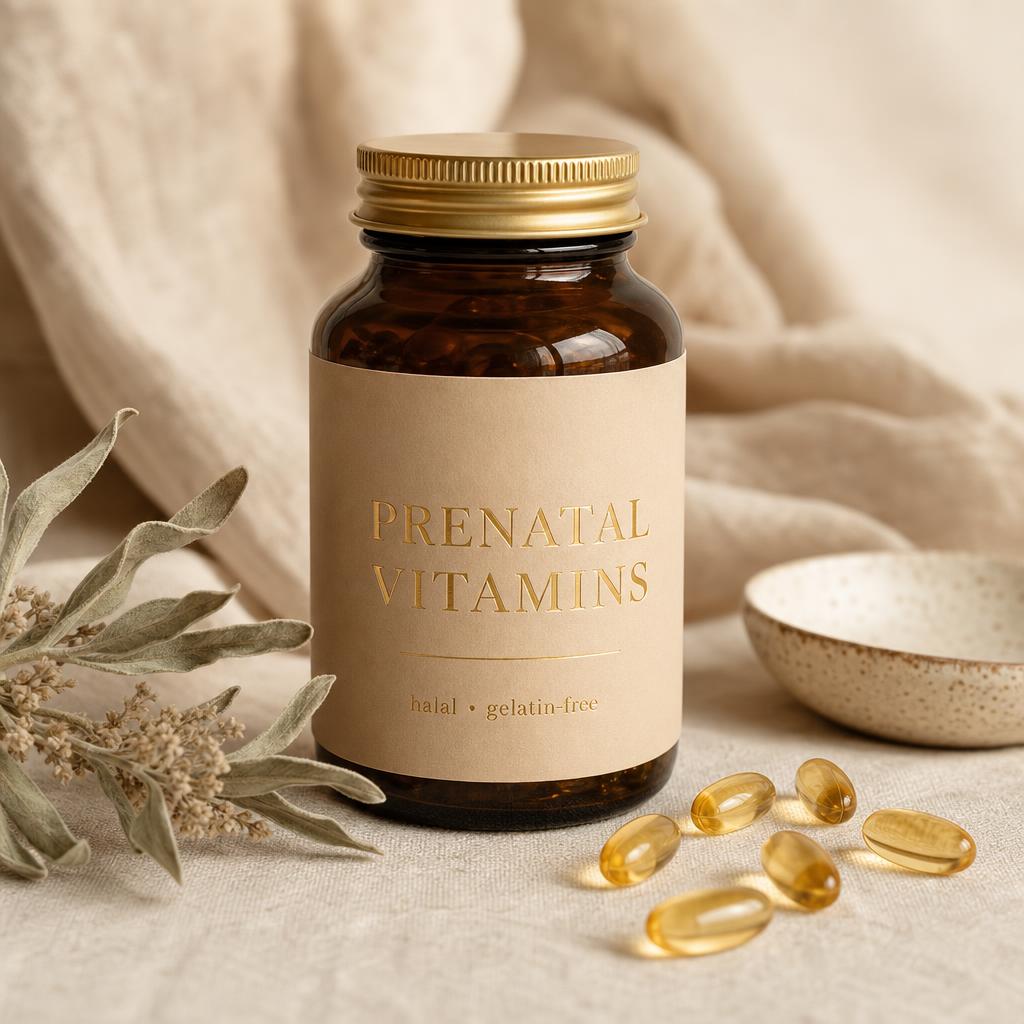
Pregnancy is the most nutritionally demanding time of a woman's life. But walk into any pharmacy and the prenatal vitamins on offer almost always contain pork-derived gelatin, synthetic folic acid, and cheap mineral forms your body struggles to absorb. Here's what to look for instead.
- Capsules: plant-based (HPMC) or fish gelatin, never bovine/porcine gelatin without halal certification
- Vitamin D3: ideally from lichen, not sheep's wool lanolin without halal certification
- Omega-3 DHA: from algae or halal-certified fish oil
- Free of: alcohol, gelatin coatings, animal-derived stearates
Folate is essential for preventing neural tube defects. But many prenatals use folic acid — a synthetic form that around 40% of women cannot efficiently convert (due to the MTHFR gene variant). Look for methylfolate (5-MTHF or L-methylfolate) — the active form your body uses directly.
- B12: methylcobalamin (not cyanocobalamin)
- Iron: bisglycinate (gentler on stomach than ferrous sulfate)
- Choline: at least 450mg — most prenatals contain none, but it's critical for baby's brain
- Iodine: 150–220mcg from potassium iodide or kelp
Ideally 3 months before trying to conceive — folate stores need time to build. Continue throughout pregnancy and breastfeeding. Always consult your midwife or doctor.
Sources & further reading
Every claim in this article is traced to either an authentic Islamic source or peer-reviewed research and public health guidance.
Science & clinical research
- 1.Prinz-Langenohl R et al., "[6S]-5-methyltetrahydrofolate increases plasma folate more effectively than folic acid in women with the MTHFR 677C>T polymorphism", Br J Pharmacol 2009.
- 2.Caudill MA et al., "Maternal choline supplementation during pregnancy and infant cognition", FASEB J 2018.
- 3.Name JJ et al. and reviews comparing iron bisglycinate with ferrous sulfate for tolerability and efficacy.
- 4.NHS — Vitamins, supplements and nutrition in pregnancy (folic acid and vitamin D guidance).
- 5.WHO — Antenatal care recommendations: iron and folic acid supplementation.
- 6.Obeid R et al., "Folate supplementation for prevention of congenital heart defects and low birth weight", and reviews on 5-MTHF vs folic acid.
- 7.EFSA — Dietary reference values for choline, iodine and omega-3 DHA in pregnancy.
Medical disclaimer: Welliyah articles are for general education and reflect Islamic wellness principles. They are not a substitute for personal medical advice. Always speak with a qualified clinician about your individual health, medication, pregnancy, or treatment decisions.